
Review · TBILISI
Tbilisi Walking Tour Including Cable Car and Traditional Bakery
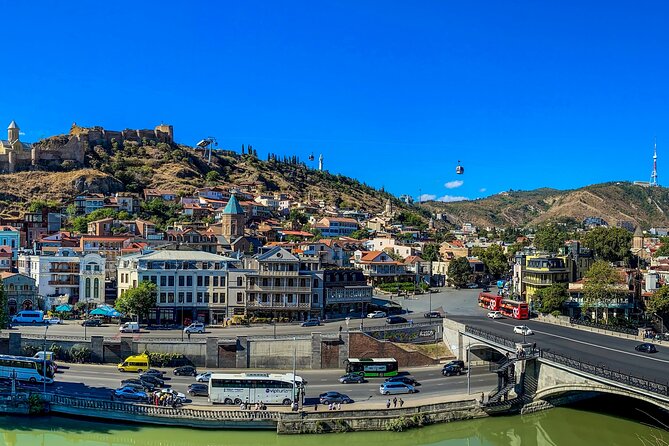
Tbilisi reveals itself best on foot, where old churches, balconies, courtyards, bathhouses, and lively squares sit close together. This four-hour walk adds a cable-car ride to Mother of Georgia and a stop at a traditional tone bakery, giving you both city views and a taste of daily Georgian culture.
I like the clear route from Avlabari to the Old Town, and I like the way the tour mixes major sights with small cultural details, such as the meaning of the tamada, Georgia’s traditional toastmaster. The main drawback is pace: some groups may find the walk relaxed, while others may feel a few stops last longer than needed.
Key points at a glance
- Cable car and city views: Ride from Rike Park toward Narikala and Mother of Georgia.
- A useful first-day tour: The route covers many central sights in about four hours.
- Traditional food included: Try a Georgian pie and lemonade at a tone bakery.
- Strong guide team: Guides named in the tour feedback include Soso, Ana, Nini, Dimitri, Ellie, Shoti, and Toko.
- Church visits require modest clothing: Women should cover their heads, and shorts are not allowed inside churches.
- Good value at $19: The guide, cable car, pastry, lemonade, and online support are included.
Why this is a smart first look at Tbilisi
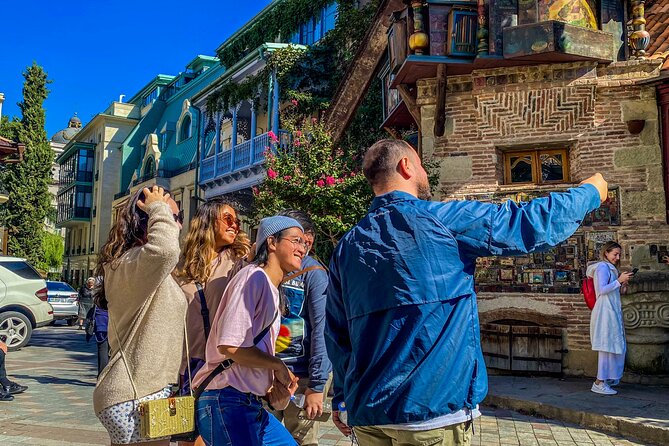
At $19 per person, this is an inexpensive way to get oriented in Georgia’s capital. You are not paying for a long-distance transfer or a day outside the city. You are paying for a local guide, a carefully linked Old Town route, a cable-car ticket, and two small food and drink experiences.
That combination matters on a first visit. Tbilisi can feel scattered at first, with the Mtkvari River, steep hills, old religious buildings, modern architecture, and bath district all pulling your attention in different directions. A guide gives those places a basic order and explains how they fit together.
The tour begins at M/S Avlabari metro station at 10:00 in the morning. It finishes at Meidan Bazar in the center of the Old Town, which is useful because you can continue exploring, eat lunch, or walk into the Abanotubani district after the tour.
The advertised group limit is 100 people, so the size may vary. The route is described as a comfortable walk, and several guide accounts praise the balance between walking, photo stops, explanations, and time at the sights. Still, a larger group can make it harder to hear, especially near busy streets or open plazas.
More Walking Tours in Georgia:
- Madrid Tapas & Wine Tasting Walking Tour – Small Group Local Bars
★ 5.0 · 3,644 reviews - Montmartre Hill French Gourmet Food and Wine Tasting Walking Tour
★ 5.0 · 2,588 reviews - Toledo Tour & Vineyard Walk with Wine Tasting from Madrid
★ 5.0 · 2,546 reviews
Starting near Avlabari and the Mtkvari River
The opening stop is a meeting space called Traveler’s Meeting Point. You spend about 15 minutes there before heading into the city. It is also described as a place for board games, music, wine, and meeting people, though the core purpose for this tour is simply gathering the group.
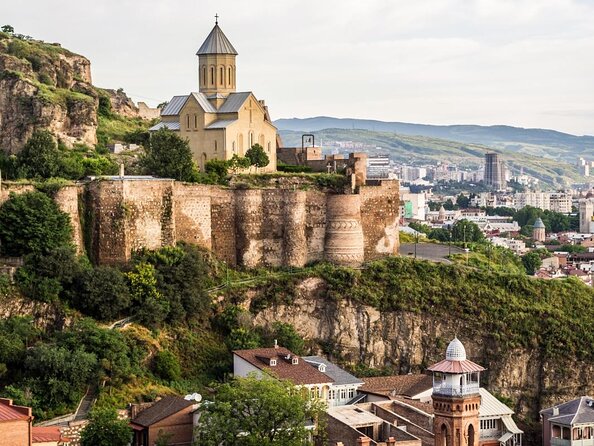
From there, you head toward Metekhi Cathedral on the cliff above the Mtkvari River. This is one of the strongest early stops because it combines a church, a dramatic setting, and the story of Tbilisi’s beginnings.
The church is linked by tradition to King Vakhtang Gorgasali, the ruler often associated with the founding of Tbilisi. Your guide may also explain the story of Saint Shushanik and the earlier religious buildings connected with the site. You get about 15 minutes here, enough for an introduction and some photographs rather than a long, quiet visit.
Nearby, the monument to King Vakhtang Gorgasali gives the founding story a human face. Vakhtang ruled Iberia, the Georgian kingdom then known as Kartli, during the late fifth and early sixth centuries. His reign involved conflict with Sasanian Iran, and Georgian tradition credits him with founding Tbilisi and reorganizing the Georgian Orthodox Church.
The dates of his reign are disputed, so this is a good place to ask your guide how history and local tradition overlap. The stop itself is brief, only about five minutes, but it helps explain why Tbilisi’s origin story appears so often around the city.
Europe Square, Rike Park, and the ride uphill
The route then crosses Europe Square, where the guide explains Georgia’s relationship with the European Union. This is a short stop, but the subject is current and important to many Georgians. It gives the tour a present-day political and cultural note among all the older monuments.
Rike Park follows on the left bank of the Mtkvari. It is a modern recreation area with fountains, climbing walls, a maze, giant chess boards, walking paths, bars, and restaurants. Families often use the park, especially in summer, and it offers a sharp contrast with the older buildings across the river.
The cable car station is in Rike Park. The ride to the upper station near Narikala takes about 10 minutes and is included in the price. This is one of the tour’s best practical additions because it saves you a steep uphill walk while giving you a broad view of the river and central Tbilisi.
The cable car may stop operating in windy weather. The tour itself runs in all weather, so bring clothing suited to the forecast. If the cable car is closed, the provider’s information does not specify a replacement arrangement, so this is one detail worth keeping in mind when you book.
At the top, you visit Kartlis Deda, usually translated as Mother of Georgia. The 20-meter aluminum statue was created by sculptor Elguja Amashukeli and installed in 1958 for Tbilisi’s 1,500th anniversary.
The statue holds a bowl of wine in her left hand for friends and a sword in her right hand for enemies. It is a simple image, but it captures a common Georgian idea of welcome paired with readiness to defend the country. You have around 10 minutes here, mainly for the view and an explanation of the symbol.
Crossing the Bridge of Peace into the Old Town
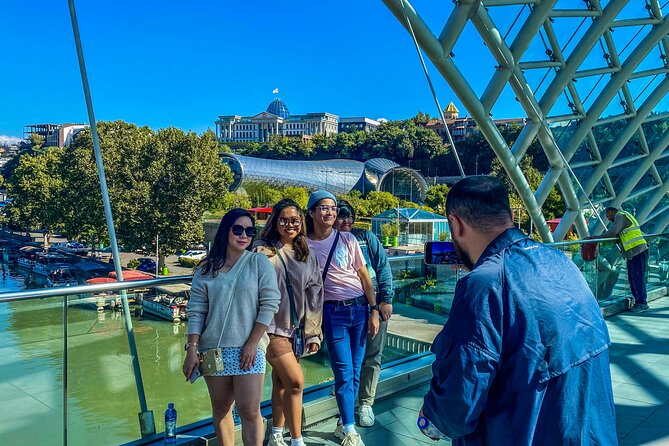
After the hilltop visit, the route returns toward the river and the Bridge of Peace. This modern pedestrian bridge opened in 2010 and links Rike Park with the Old Town. Its curved glass and steel structure stretches 156 meters across the Mtkvari.
More than 10,000 LED bulbs light the bridge each evening, switching on 90 minutes before sunset. The morning tour will show you the structure in daylight. If you choose an evening departure when available, you may see the lights, though the supplied meeting details specifically list a 10:00 a.m. start, so confirm the time at booking.
The bridge is visually striking, but it can feel quite different from the old streets nearby. That contrast is part of the point. Tbilisi is not a museum frozen in one period. Soviet-era buildings, modern public works, medieval churches, bathhouses, and renovated cafés all share the same compact center.
The walk continues to the Patriarchate of Georgia, where you hear facts about the institution and its role in Georgian religious life. The stop lasts about five minutes.
Anchiskhati Basilica gives you a longer look at early Georgian church architecture. It dates to the sixth century and was built under Dachi Ujarmeli, according to historical sources. It was originally dedicated to the Birth of the Virgin Mary.
The name Anchiskhati came later, after a revered image was moved from the Anchi church to this building in the seventeenth century. The story also connects the church with generations of calligraphers and church custodians. You have about 10 minutes here.
Dress matters inside these churches. Shorts are not allowed, and women need to cover their heads. Bring a scarf if you do not want to rely on one provided at the church.
Same town, a different glass:
- Day Trip to Kakheti Wine Region Including 9 Wine Tastings
★ 5.0 · 2,774 reviews - From Tbilisi: Kakheti Wine Region Tour with 9 Wine Tastings
★ 4.9 · 2,541 reviews - Tbilisi: Kakheti Wine Region Tour with 10 Wine Tastings
★ 5.0 · 2,160 reviews - Kakheti Wine Region: Signagi and Bodbe Tour with 10 Wine Tastings
★ 5.0 · 1,019 reviews
Clock towers, cathedrals, and Georgian stories

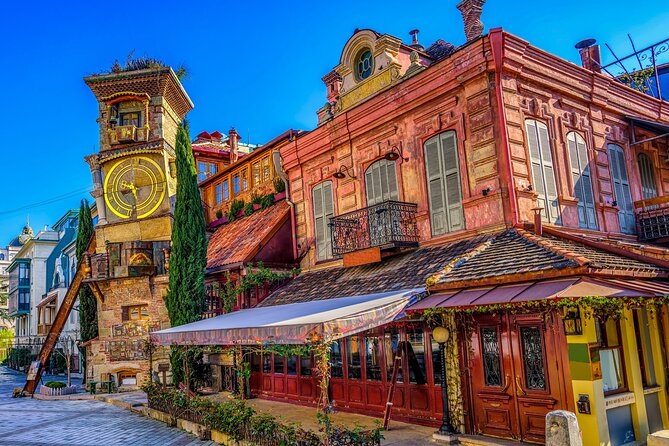
The Rezo Gabriadze Marionette Theater is one of the city’s most unusual stops. Next to the theater is a crooked-looking clock tower built in 2010 by artist and puppeteer Rezo Gabriadze. Every hour, an angel appears with a small hammer to ring the bell.
A short puppet show called The Circle of Life is performed at noon and 7:00 p.m. The walking tour does not promise that you will see the show, but the tower is worth a pause for its hand-decorated tiles and playful design. The 10-minute stop gives your guide a chance to explain why this small building has become one of Tbilisi’s familiar symbols.
Sioni Cathedral comes next. It sits on Sioni Street in one of the Old Town’s oldest areas, Upper Kala. Local tradition links the first church on the site to Vakhtang Gorgasali in the fifth century.
This part of the route is especially useful if you are trying to understand Georgia’s Christian identity. The churches are not simply old façades. They remain places of worship, so keep your voice low, dress respectfully, and follow the guide’s instructions.
A taste of Tbilisi at the tone bakery

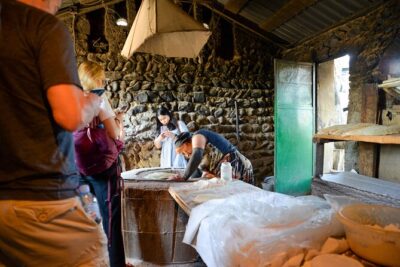
The tone bakery is the tour’s most direct food experience. You taste a traditional Georgian pie and drink Georgian lemonade, both included.
A tone is a traditional clay oven used for Georgian bread and baked dishes. The stop is short, about 15 minutes, but it breaks up the church visits and gives you something concrete to remember from the walk.
The tour information refers to a traditional Georgian pie, while some food examples connected with this route describe khachapuri. Khachapuri is Georgia’s famous cheese-filled bread, but the exact item can vary, so do not assume you will receive a particular regional style. Either way, this is a snack-sized introduction rather than a full meal.
Plan to eat before the tour if you need a substantial breakfast. Four hours of walking, even at an easy pace, can make a small bakery tasting feel more like a welcome pause than lunch.
Tamada, Shardeni Street, and the sulfur district
The tamada statue introduces one of Georgia’s most important social traditions. A tamada is the toastmaster who guides a Georgian feast, offering toasts to family, friendship, peace, ancestors, and the occasion at hand.
This short stop is more than a photo opportunity. It explains why wine and formal toasts have such a large place in Georgian hospitality. The tour’s listed inclusions cover pie and lemonade, not wine, so treat this as a cultural explanation rather than a promised tasting.
Jan Shardeni Street is a pedestrian area in the Old Town lined with restaurants, bars, and shops. It is one of the city’s most popular central streets and can feel more commercial than the quieter lanes nearby. I like it as a quick orientation point, but you may want to return later if you hope to explore at a slower pace.
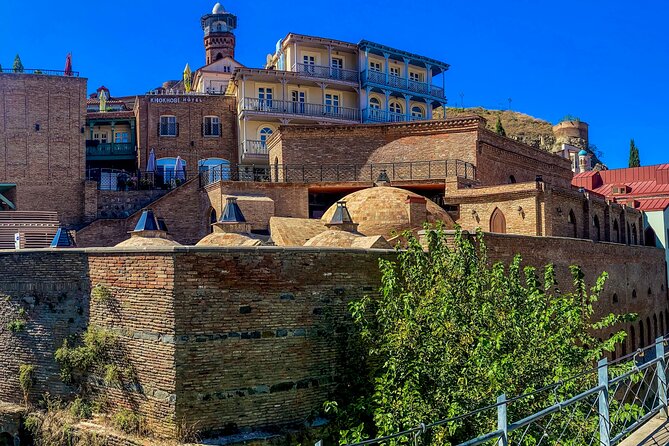
The final stretch leads into Abanotubani, the sulfur-bath district. Tbilisi’s name is traditionally connected with its hot springs, and the neighborhood still has a row of public bathhouses using sulfurous water.
You do not receive a bathhouse session on this tour. The stop is brief, about five minutes, so think of it as an introduction. If you want to use a bath later, ask your guide for practical advice, then make a separate reservation.
The walk ends at Leghvtakhevi Waterfall, a small urban waterfall reached from the bath district. It is a pleasant finish because the path feels tucked into a narrow gorge, even though you are still in the center of the city. The stop lasts about five minutes, giving you time for photos before the official tour ends at Meidan Bazar.
Guides, pace, and the human side of the tour
The guide can shape this experience more than any single monument. Guides named in the tour material include Soso, Ana, Nini, Dimitri, Ellie, Shoti, Toko, Nika, Iva, Elena, Mika, Luca, and Nene.
The strongest pattern is clear English, friendly delivery, good answers to questions, and useful stories about everyday Georgia alongside the formal dates. Soso is described as patient, energetic, and good at balancing explanation with free time. Ana is praised for answering questions and making the history easy to follow. Nini and Nene are noted for their warmth and enthusiasm, while Dimitri is described as attentive to the whole group.
One caution is pace. Mika’s tour was considered a little slow by one participant, with some stops lasting longer than necessary. That is not a serious problem if you like details and photographs. If you prefer to move quickly, tell your guide early that you would rather keep the walk flowing.
Who should book this $19 tour?
I would choose this tour for a first morning in Tbilisi, especially if you want a basic map of the center before exploring alone. It suits adults, families with children aged five and older, and anyone who wants major sights without arranging separate tickets.
It is also a good fit if you like a mix of history, religion, food, architecture, and views. The route does not focus deeply on one subject, but it gives you many starting points for later visits.
You should think twice if you dislike group walks, need a private pace, or want extended time inside every church and attraction. The tour covers a lot in four hours, so several stops are introductions rather than full visits.
The provider accepts mobile tickets, offers the tour in English, and confirms bookings at the time of purchase. Free cancellation is available up to 24 hours before the start time. The tour runs in all weather, and the maximum group size is listed as 100.
Should you book it?
Yes, if you want an affordable first look at Tbilisi with a guide, a cable-car ride, a local snack, and a finish in the Old Town. The route is well chosen, and the $19 price is hard to fault for the number of central sights covered.
Book it early if your schedule is tight, since it is commonly reserved well ahead of time. Wear comfortable shoes, bring a scarf for church visits, and keep your expectations realistic: this is a broad city introduction, not a private deep study of every monument.
FAQ
How long is the Tbilisi walking tour?
The tour lasts approximately four hours.
What time does the tour start?
The listed start time is 10:00 a.m.
Where does the tour begin?
The meeting point is at M/S Avlabari in Tbilisi, near public transportation.
Where does the tour finish?
The tour ends at Meidan Bazar in the center of Tbilisi’s Old Town.
Is the cable-car ride included?
Yes. The cable-car ride from Rike Park to the upper station near Narikala is included.
What food and drink are included?
The tour includes a traditional Georgian pie and Georgian lemonade.
Is the tour offered in English?
Yes. The tour is offered in English.
Can children join the tour?
The minimum age is five years old.
What happens if the weather is windy?
The tour operates in all weather conditions, but the cable car will not operate during windy weather. Dress according to the forecast.
Just added around Georgia
- Wine and Dine Tour To Batumi Waterfalls – Mountainous Adjara★ 5.0 · 51 reviews
- Tbilisi: Irine’s Pub Crawls★ 4.7 · 52 reviews
- Tbilisi: Kakheti Region,Signaghi Tour with 9 Wine Tastings★ 4.8 · 431 reviews
- Tbilisi: City Pub Crawl with welcome shots in game format★ 4.5 · 85 reviews
- Private Wine tasting in Historic Karalashvili Wine Cellar★ 5.0 · 60 reviews
- from Tbilisi to Kakheti Tour Sighnaghi, Bodbe & Wine Tasting★ 4.7 · 49 reviews
- From Tbilisi: Kakheti Wine Region Tour with 9 Wine Tasting★ 4.8 · 196 reviews
- Batumi: Wine & Dine Tour To Waterfalls – Mountainous Adjara★ 4.9 · 363 reviews
Tbilisi Drinks Tours, compared.
Day Trip to Kakheti Wine Region Including 9 Wine Tastings
Read our review →
Kakheti Wine Region Tour with 9 Wine Tastings
Read our review →
Kakheti Wine Region Tour with 10 Wine Tastings
Read our review →
Kakheti Wine Region: Signagi and Bodbe Tour with 10 Wine Tastings
Read our review →
Mtskheta,Jvari,Bazaar,wine tasting,Chronicles of Georgia
Read our review →
Kakheti Region,Signaghi Tour with 9 Wine Tastings
Read our review →
City Pub Crawl with welcome shots in game format
Read our review →
Private Wine tasting in Historic Karalashvili Wine Cellar
Read our review →Browse the lists this tour appears in